L2 Upsilon code information
Total 12 input parameters (adjustable from control GUI):
prescale=1
L0SeedThreshold= 4.00 (GeV)
L2SeedThreshold= 2.50 (GeV)
MinL0ClusterEnergy= 4.50 (GeV)
MinL2ClusterEnergy= 3.00 (GeV)
MinInvMass= 5.00 (GeV)
MaxInvMass= 20.00 (GeV)
MaxCosTheta= 0.00
MaxDynamicMaskedTowers= 25 this is the maximum number of masked
towers
HotTowerThreshold= 2.500000 (GeV) this is the threshold to define
whether the tower is hot
HowManyEventsPerUpdateDynamicMask= 50 the towers are evaluated
for 'dynamic masking' every 50 events (to save CPU time)
fThresholdRatioOfHotTower= 0.50 (hot# / event#)
'hot ratio' for a tower; here it means if a tower is hot more
than 25 times in 50 events, then it will be masked
Saved out histograms
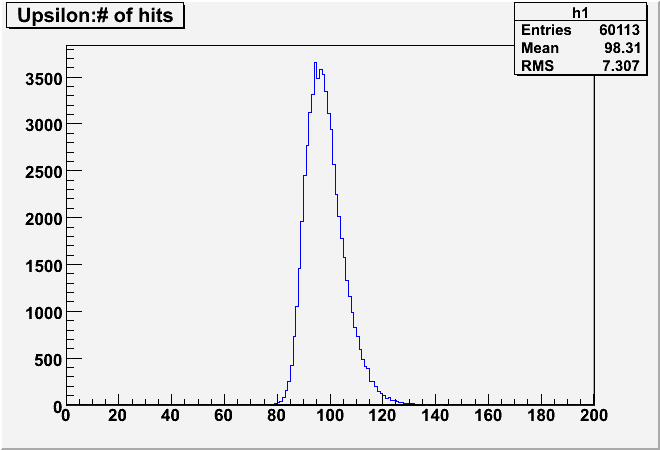
1. number of all tower hits (event-wise)
2. energy of all tower hits (before dynamic masking)
3. number of L0 candidates vs. number of L2 candidates (event-wise)
5. energy distribution of L0 seeds
6. energy distribution of L2 seeds (plot 5 & 6 are generated from plot 2 with dynamic masking and threshold cuts)
7. cluster energy distribution of L0 candidates
8. cluster energy distribution of L2 candidates
10. InvMass of accepted L0+L2 pairs
11. number of masked towers (this histogram is filled every 50 events)
12. the softid of masked towers (this histogram is filled every 50 events)
901. the CPU time (kTics) (a test shows the CPU time is ~ 50 usec)
The following plots are generated from a test with input of real pp 200 GeV data, Run=9067013
Total input 60113 events, accept 319 events


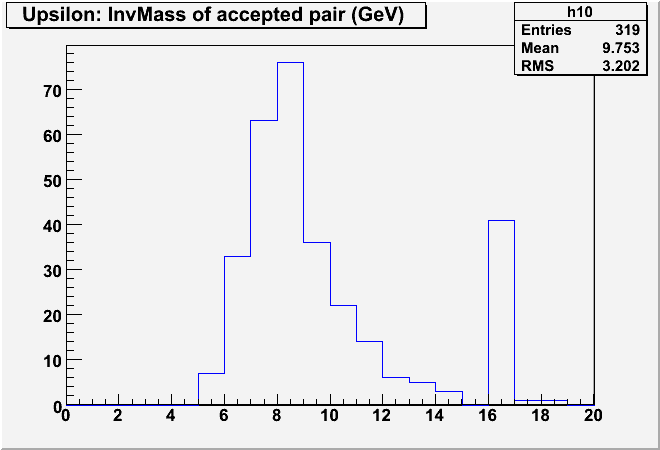
comment: the large entries at 17 GeV is due to hot towers. For the 1st 50 events of each run, NONE of the towers is masked


comment: 2 peaks are due to the input data have 2 main type of triggers. The average time (say 100 kTics) is about 50usec for the given 2GHz CPU